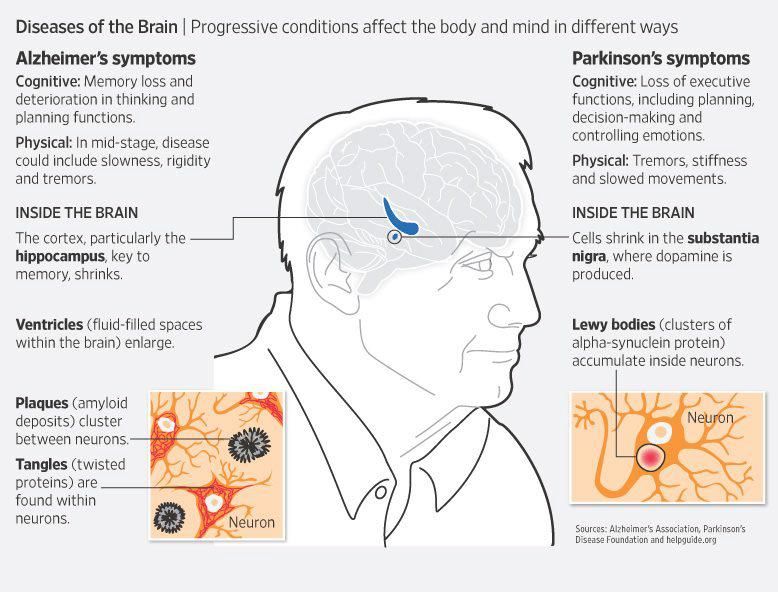
Parkinson’s disease symptoms are primarily motor-related and include tremors, slowness of movement (bradykinesia), muscle stiffness, and balance problems. Other symptoms can include a reduced sense of smell, constipation, sleep disorders, and mood changes like anxiety or depression. These symptoms often start gradually and worsen over time.
Motor symptoms
Tremor: A rhythmic, involuntary shaking that typically starts in a hand, arm, leg, or jaw, often when the limb is at rest.
Slowness of movement (bradykinesia): Slowed movements and a decrease in spontaneous and voluntary movement, which can lead to a smaller step size while walking or less arm swinging.
Rigidity: Muscle stiffness and stiffness in joints that can be detected by a doctor.
Imbalance and coordination issues: Difficulty with balance and coordination, which can lead to falls.
Gait problems: Can include freezing of gait, where a person feels as though their feet are “stuck” to the floor.
Non-motor symptoms
Loss of smell: A reduced or complete loss of the sense of smell.
Constipation: Difficulty passing stool, often occurring less than three times a week.
Sleep disorders: Problems like restless leg syndrome, excessive daytime sleepiness, or REM sleep behavior disorder.
Mood disorders: Anxiety, apathy, or depression.
Voice changes: Speaking more softly than usual or having a breathy or hoarse voice.
Handwriting changes: Writing may become smaller and more cramped (micrographia).
Facial changes: A “masked face,” or a serious look on the face even when not feeling that way, due to reduced facial muscle movement.
Pain: Muscle or joint pain and cramps.
Blood pressure changes: Dizziness or lightheadedness when standing up due to a sudden drop in blood pressure (orthostatic hypotension).
Sexual dysfunction: Decreased desire or performance.
Early signs
Mild tremors
Difficulty getting out of a chair
Speaking too softly
Cramped handwriting
Loss of smell
Constipation
Sleep problems
Unexplained mood disorders

