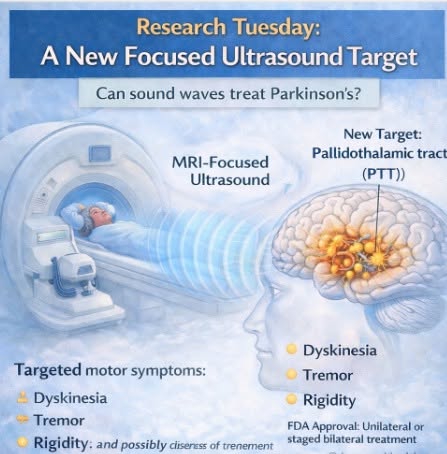
MRI-guided focused ultrasound, which has been available for several years, is a non-invasive treatment that uses precisely targeted sound waves to treat specific brain circuits — without incisions or implanted hardware. Until recently, however, this approach has had some important limitations.
At this year’s Movement Disorder Society Annual Meeting, researchers highlighted growing interest in a new brain target called the pallidothalamic tract (PTT). Because this pathway sits closer to the center of the brain, it can be easier to reach and may allow for greater precision during treatment.
Early research suggests that targeting the PTT may help improve:
• Dyskinesia (involuntary movements)
• Tremor
• Rigidity, and possibly slowness of movement
Importantly, this approach has now received FDA approval for unilateral and staged bilateral treatment, expanding options for people who may not be candidates for deep brain stimulation (DBS).
 :
:Focused ultrasound offers a non-surgical option for managing difficult Parkinson’s symptoms, particularly dyskinesia. While it isn’t right for everyone, it represents meaningful progress in expanding individualized treatment choices — especially for those who cannot undergo DBS surgery.
 This treatment does not slow disease progression, but it may significantly improve quality of life for selected patients when symptoms are difficult to control.
 :
:Medscape Medical News. (2025). Highlights from the Movement Disorders Society Annual Meeting.