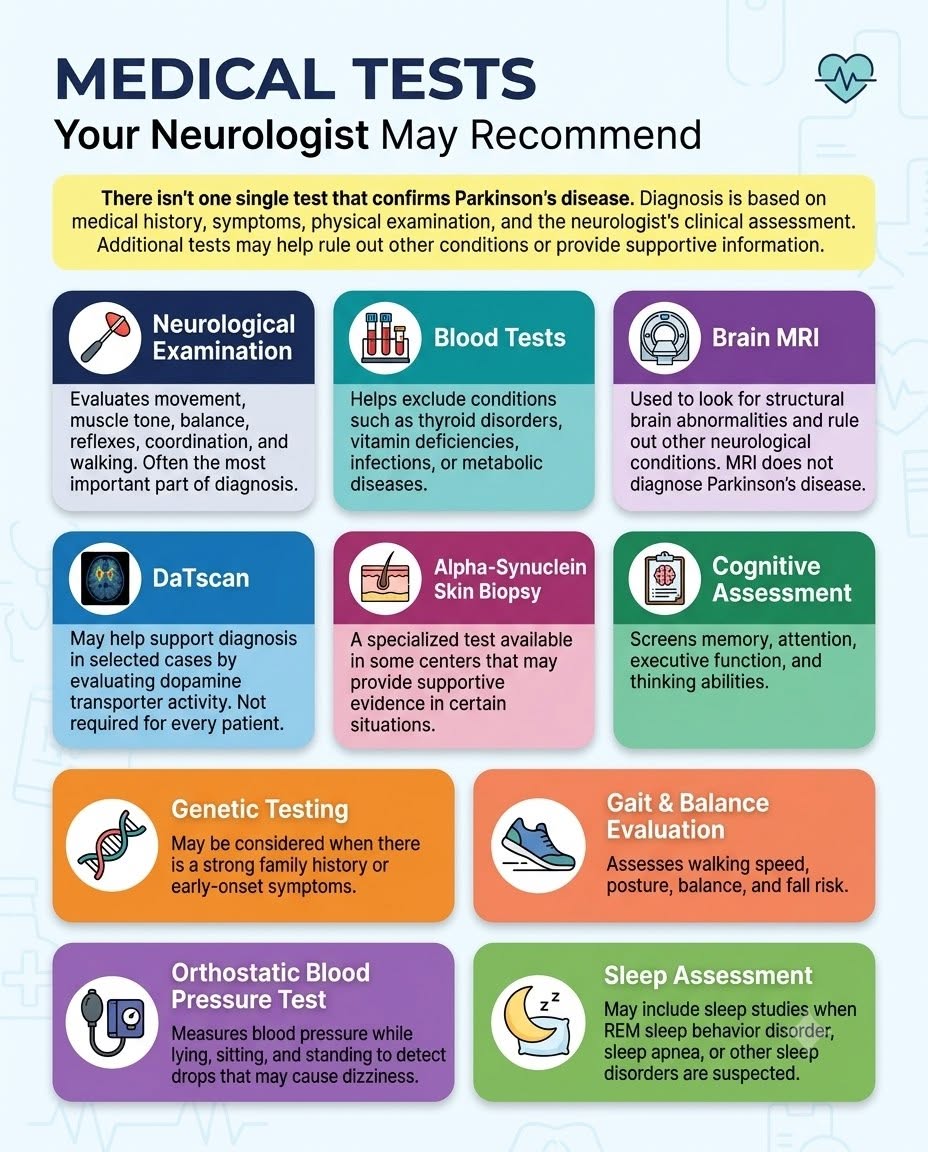
One of the biggest surprises after being diagnosed with Parkinson’s disease is the number of appointments, evaluations, and medical tests that may follow.
If you’re newly diagnosed, it can feel overwhelming. You may start wondering, “Why do I need all of these tests?” or “Does this mean my Parkinson’s is getting worse?”
The good news is that most of these tests are not looking for bad news. They’re designed to help your neurologist understand your symptoms, rule out other conditions, establish a baseline, and make the best treatment decisions for you.
The first thing to understand is this:
There is no single test that diagnoses Parkinson’s disease.
Unlike many illnesses, there isn’t a blood test, X-ray, or MRI that can simply say, “Yes, you have Parkinson’s.”
Instead, your diagnosis is usually based on a combination of:
• Your symptoms
• Your medical history
• A neurological examination
• How your symptoms change over time
• Sometimes, how you respond to Parkinson’s medication
• Occasionally, additional testing when needed
Here are some of the tests your Parkinson’s doctor may recommend and what you can expect.
 Neurological Examination
This is the most important evaluation you’ll have.
Your neurologist may ask you to:
• Walk across the room
• Turn around
• Tap your fingers
• Open and close your hands
• Move your feet
• Stand from a chair
• Check your balance
• Test your reflexes
• Follow a finger with your eyes
None of these tasks are meant to embarrass you. Your doctor is looking for movement patterns such as slowness, stiffness, tremor, balance changes, reduced arm swing, and coordination. These observations often provide more useful information than any scan. 

–
For Free Tips Click Here: https://tinyurl.com/Parkinsons-Health
.
.
.
.